Card Set of Living Heritage
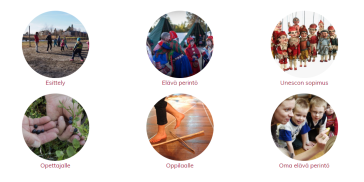
The living heritage picture card deck, compiled by the Finnish Heritage Agency and the Association for Cultural Heritage Education in Finland, introduces learners of all kinds to the world of living heritage.
What is living intangible cultural heritage in today’s Finland? What kinds of traditional examples do we have related to crafts, nature, or music? And what kinds of traditions are found among Finland’s many different minority groups?
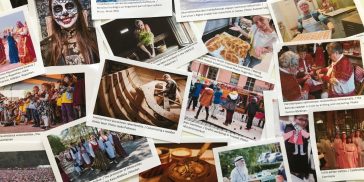
The Living Heritage card set consists of fifty images related to intangible cultural heritage. It includes everything from mushroom picking, sauna traditions, and kalakukko delicacy to the game of kyykkä. The traditions of diverse cultures from Ukraine to Mexico and from Syria to India are also strongly represented. The images come from UNESCO, the Finnish Heritage Agency, the Helinä Rautavaara Museum, and the cultural association Interkult. Images from Finland’s National Inventory of Living Heritage are also included.
The cards can be downloaded and printed for different groups to use from the Finnish Heritage Agency’s website Opi.aineetonkulttuuriperinto.fi. The cards offer an easy and approachable way to explore familiar or unfamiliar forms of cultural heritage.
They have been tested with learners from primary school to upper secondary school, as well as with students, teachers, hobby groups, and older adults. The cards also work well as an introductory activity for workplace wellbeing days—after all, research shows that cultural heritage enhances wellbeing!
How to use the Card Set of Living Heritage:
Print and cut out the cards, then spread them out on a table. Each participant chooses a card they find pleasant or interesting and introduces the card and the tradition it represents to a partner, small group, or the whole group—while also introducing themselves.
In the introduction, they might mention why they chose the card, what they know about the tradition, why it is interesting, from whom they may have learned the tradition, and to whom they themselves pass it on.
The cards highlight the diversity of cultural heritage in Finland. They work well as a tool in, for example, preparatory education groups or culturally diverse classrooms, where the cards can help reflect on what people already know about their own and others’ cultural heritage.
We are happy to tell you more!
Leena Marsio, leena.marsio(at)museovirasto.fi
Ira Vihreälehto, ira.vihrealehto(at)kulttuuriperintokasvatus.fi